Thursday, May 15, 2008
Proposed Truth Commission Bill Seriously Flawed
Parliament Should Amend Legislation to Close Loopholes
“The national dialogue and reconciliation process was supposed to create institutions that can address Kenya’s historical injustices and bring criminals to book for their crimes,” said Georgette Gagnon, Africa director at Human Rights Watch. “But as currently drafted, the commission has serious flaws that must be urgently addressed by parliament, especially its amnesty provisions.”
If the contradictions in the draft bill are not resolved, the Truth, Justice and Reconciliation Commission (TJRC) could fail to contribute to or even undermine the justice which Kenya so badly needs. The Kenyan parliament should take time to reflect on the bill and amend it to rectify the flaws rather than passing it into law with undue haste.
The serious questions that parliament must address in the committee stages of revising the bill are:
- The amnesty provisions as proposed are inconsistent with Kenya’s obligations under international law, which rejects impunity for serious crimes, such as genocide, war crimes, crimes against humanity, and torture. International treaties, including the UN Convention against Torture, the Geneva Conventions, and the Rome Statute of the International Criminal Court, require parties to ensure alleged perpetrators of serious crimes are prosecuted. Kenya has ratified each of these in addition to numerous other human rights treaties.
- Although the draft law states that the TJRC will not grant amnesty for “crimes against humanity or genocide within the meaning of international human rights law,” it does not mention war crimes or acts of torture not amounting to crimes against humanity. The bill should provide that the TJRC will comply with established international human rights law and should clearly exclude amnesty for genocide, crimes against humanity, war crimes, and torture. The bill should also make perpetrators of crimes of sexual violence ineligible for amnesty.
- The independence of the commission is severely compromised in the current draft because Article 40 gives the Minister of Justice and Constitutional Affairs the power to scrutinize and approve the commission’s expenses, allowances, and budget. This provision effectively gives the government control over the activities of the commission.
- Article 23 of the draft bill gives witnesses immunity, but Article 3 says the commission is a legal body that can sue and be sued. The commission should be given immunity from being sued for its actions as a court to prevent it being obstructed by spurious lawsuits.
- Kenya has had numerous previous bodies that have documented many of the crimes under scrutiny by the TJRC. The TJRC thus risks re-inventing the wheel. Where comprehensive and clear recommendations have been made before (such as those of the Ndung’u Commission, the Akiwumi report, and the Kiliku report), the TJRC could simply require their implementation.
- The draft appears to limit its work on land issues to the “irregular and illegal acquisition of public land.” All illegal land deals should be the subject of investigation.
- Nowhere in the draft does it clearly state that the work of the commission will not replace conventional police investigations and prosecutions, nor should the existence of the commission be an excuse for such investigations to cease. It should be stated that the police response to recent and previous crimes is of vital importance and should continue in the normal way.
- The draft bill gives the commission only two years to address all forms of historical injustices, including corruption, land issues, and reparations for victims. This array of injustices is very wide. It would be better if the commission was given a much longer life, or perhaps the scope of its investigations was reduced, for example with land and compensation issues being dealt with separately.
Background
The need for a TJRC to inquire into historical injustices, systemic human rights violations, economic crimes, and the illegal or irregular acquisition of land by previous governments was first acknowledged by the incoming National Rainbow Coalition government in 2003. That
government appointed a Task Force on the Establishment of a TJRC, chaired by Professor Makau Mutua. The task force recommended the creation of a TJRC before June 2004, with a specific mandate, powers, and functions. However, its recommendations were ignored by the government.
Following the violence triggered by the controversial 2007 presidential elections, the Kenya National Dialogue and Reconciliation Committee, led by former United Nations Secretary-General Kofi Annan, agreed to set up a Committee to Investigate the Post-Election Violence and a TJRC to examine historical injustices up to the end of 2007. The government
drafted the law that is currently before parliament with input from some civil society organizations.
For more of Human Rights Watch’s work on Kenya, please click HERE:
Wednesday, May 14, 2008
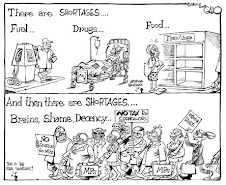
GRAND POLITICAL BUDGET
Tuesday, May 13, 2008
WAJIBU: REDEFINING OURSELVES
If we really wish never again to see a repetition of the traumatic events that we experienced after the 2007 elections, we CANNOT AND WE MUST NOT bury the memory of what happened in the early months of 2008.
WAJIBU, in this first double first issue of the year brings you not simply the events of that period as lived by many Kenyans but also the reflections of thoughtful writers (many of them young but established) on the underlying reasons for this outbreak of violence. At the same time, we give you the thoughts of religious leaders as well as of social activists on the paths we must choose if we wish to live in “unity, peace and liberty” in the Kenya we love.
Some of the well-known writers and leaders who have contributed to this issue are: Sheikh Said Athman, Muthoni Garland, Shalini Gidoomal, Fr. Patrick Kanja, Mukoma wa Ngugi, Yvonne Owuor, Stephen Partington, Binyavanga Wainaina and Rasna Warah.
WAJIBU can be obtained for Ksh. 100/= at the following outlets: Stanley Kiosk, Simply Books, University of Nairobi Bookshop, Catholic Bookshop, LISS library at the Rahimtulla Trust Building on Mfangano Street, Books First (Yaya Centre) and Monty's (Sarit Centre).
Or contact Editors: Dipesh Pabari (dpinkenya (at) yahoo.co.uk or Wakuraya Wanjohi (wakurayag (at) yahoo.com)
Monday, May 12, 2008
FORCED CLOSURE OF IDP CAMPS IN KENYA
FROM: The National Internally Displaced Persons Network of Kenya
URGENT ACTION: May 9, 2008:
FORCED CLOSURE OF IDP CAMPS IN KENYA
The National IDP Network asks that the Government of Kenya recognize its responsibility to protect these victims of violence including many children. According to the guiding principles, which it has agreed to in the Great Lakes Pact, the government is also required, to give the displaced choices and alternatives to returning to the site of very recent trauma.
By closing the camps the government is in effect forcing people to return or face starvation, disease and perhaps home in a slum. Such scenarios are likely to breed more poverty and recruits for gangs and future violence. Few seem to remember that Mungiki was a product of the 1991-92 violence and that we are in danger of magnifying and multiplying such groups if we do not deal with both the sites of violence and the trauma and plight of the displaced in a comprehensive manner.
It should also be noted that a number of those IDPs who have agreed to be taken back to such places as Kuresoi have experienced threats, violence and no services. At least one man has committed suicide on return, and many have literally returned by foot to the camps. In Nakuru, the site of one of the largest camps the government discontinued water five days ago to the camp causing much distress and the potential outbreak of disease. Residents have been forced to send children out to collect water and tomorrow they will bury a child killed by a car on one desperate mission to collect water. This is no way to treat victims of violence who are already traumatized.
We are asking concerned citizens and friends of Kenya to take urgent action:
- Ask the Kenya Red Cross and international partners to end any complicity in forced returns. Water must be restored to the Nakuru camp immediately. The Kenya Red Cross can be e-mailed at info@kenyaredcross.org or texted at 722-206958 or 733-333040
- Ask the Kenya National Commission for Human Rights to investigate and monitor the ongoing Resettlement and camp closures and to demand that the government recognize the Guiding Principles as the legal framework for dealing with IDPs. Commissioner Maina Kiai can be reached at mkiai@knchr.org.
- Ask the government to create an IDP policy that includes some alternatives, which could be in the form of reinstatement of salaries for displaced government employees, monetary compensation, trauma counseling and help in individual relocation choices. Some IDPs have also suggested that they enter into temporary farming arrangements on underutilized land until reconciliation and security can be restored.
- Ask the Government to recognize that some IDPs will prefer to relocate in other parts of the country including Nairobi to do business rather than return. This must be respected and the Ministry of Special Programmes must work with the Ministry of Lands to find alternatives as well as temporary farming arrangements for those who do not wish to return. Finally, urge them to restore water to the Nakuru camp immediately. Dr. Naomi Shaban can be texted at 722814412.
CLICK HERE to read news article in Standard by Vincent Bartoo on IDP resettlement
Wednesday, May 7, 2008
Operation Rudi Nyumbani
The statement below was released by PeaceNet
Although the displaced people in some of the IDP camps welcome the move, most of them are concerned about the guarantee of their safety and access to basic necessities (food, shelter, health, education and sources of livelihoods) once they return to their farms. Most of the displaced people could not escape with anything when the violence erupted, while their homes including food stores were burnt down and other property stolen.
In the North Rift region, peace and faith based organizations are of the opinion that inter-community dialogue should have been given a priority to give the warring communities a chance to discuss their differences before the resettlement exercise is undertaken.
Reports indicate that some members of the host communities were complaining that they were being forced to co-exist with their neighbours instead of being given a chance to discuss their differences and find a common ground for co-existence. They say that they had raised
issues of concern that needed to be critically addressed if a lasting peace solution was to be achieved in the region.
It is reported that most people fear that once the resettlement of the displaced people is done, long term issues that have always divided the communities leading to inter-ethnic conflict experienced in the areas would be forgotten. They feel that if this was not addressed, violence
might be experienced again in the future.
Some IDPs on the other hand feel that they were not ready to return to their farms unless their security was guaranteed. Some are of the view that the host community should have been persuaded enough to accept to receive them unconditionally.
The Catholic Church, (Eldoret Diocese), is reported to have been spearheading crucial inter-community dialogue meetings in Burnt-Forest, one of the post election hot spots and a traditional inter-ethnic violence prone area. These dialogue meetings are credited for easing the high tension that persisted until recently in the area. The meetings are also said to have encouraged the warring communities to embrace forgiveness and reconciliation.
The church convened one such dialogue on Sunday,
The elders were planning to hold a joint meeting with elders and youth from both communities living in three of the 21 farms in Burnt-Forest on
In Molo, another violence hot spot area, some IDPs are said to have relocated back to their farms amid fear and anxiety as the host community complain that they were never involved in the resettlement process of their neighbours. The returnees are reported to have carried the tents they were using at the camps to use them for shelter in the meantime at their farms before they reconstruct their homes. In the South Rift region, most people view that the resettlement plan has been rushed and it is not the right time for the displaced people to return.
According to Francis Murei, the Kericho, Catholic Justice and Peace Commission (CJPC) Coordinator, dialogue should have been given a priority to ensure that the warring communities were willing to co-exist unconditionally. He says sentiments from some youth in the region indicate that they were still repulsive and not willing yet to accept their neighbours. He views that the resettlement exercise should not be given a blanket approach, but undertaken according to the diverse needs of the displaced people.
In the Central Rift region, he identified four categories of IDPs whom he views required unique approaches. These include traders, farmers, employees and squatters. It is reported that while some IDPs were ready to return to thir homes, others are said to have vowed that they would not be returning to their homes for fear of future attack.
According to the CJPC, eight schools were burnt down and 231 teachers displaced in the region during the violence and this would present another problem to returnees as children would not be able to learn.
In Kisii, the over 2,000 IDPs living in the camps are said to be concerned about the security situation in the places where they were displaced from. Others report that their homes and other properties had been occupied by their attackers and may not be able to reclaim them.
Most of them feel that the root causes of the violence had not been addressed to ensure that their neighbours would be happy to have them back to their homes. They say that even if they were to return to their homes, they had lost all their property and had nothing to begin reconstructing their lives with.
They feel that the government should have first instituted a reconstruction plan including a justice system to address their plight before sending them away from the camps.
Other development experts view that the resettlement plan being undertaken is widely perceived as forced and that it may not be sustainable in the long run. They say that before undertaking such a drastic measure, the government should have ensured that communities are given a chance to discuss on their differences and come-up with viable solutions towards mutual coexistence.
They are concerned that if one of the communities feels that they are being forced to live with another, future reconciliation talks would be compromised. They say that cultural peace mediation structures among the various groups in the communities such as elders, youth and women among other groups should have been identified and used to help bring together
the warring communities.
According to experts community dialogue among the warring groups will help people feel each other's concerns as well as changing negative attitudes towards one another.
Kenneth Kibet
Information Officer
Peace And Development Network Trust
(PeaceNet - Trust )
Website: www.peacenetkenya.org
Sunday, May 4, 2008
Sukuma Kisumu - Where we are
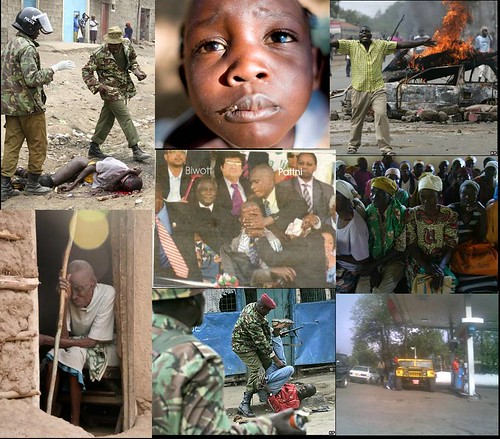
On 27th December 2007, the Election Council of Kenya announced the results of the presidential elections. The story that followed is one that has been told from 1001 fingers, mouths and eyes. There was little we could do besides watch in fear as the wrath of poverty spilled across the country. The violence subsided and hundreds of thousands across the country squatted in displacement mourning the loss of friends and relatives, homes and shambas.
people with links to Kisumu to help do what they can. In just over one month after putting out an appeal for funds, £9168 was raised. Ladies In Action set out to help as many people as possible through basic food provisions, transport away from ethnic persecution, distribution of basic necessities and assisting people getting on their feet again.
Thanks to the Susan Deans who founded the Kisumu Orphans Education Fund, we were able to set up a paypal account to receive the donations from all our friends and friends of friends. It never ceases to touch my soul when I think about the fact that hundreds of people donated.
Unfortunately, we had a few hiccups with transferring the cash to the account in Kisumu and Ladies In Action were often forced to use funds from other sources. We have just managed to confirm that all the funds are no accessible and after balancing the books, there is still £3712 left from the Sukuma appeal fund which will be used for more long term sustainable small projects. With so many people affected in the Kisumu region and the ever rising cost of food, Ladies In Action will do what they can to help provide food security through helping people farm land in a more productive and environmentally friendly manner. It is a drop in the ocean but we all know that is all we can do. A break down of funds below:
Those of you who have been following this blog would have noticed that Sukuma Kenya has changed tack. We are angry. The politicians got away with murder. Their hands are covered in blood. It is that simple. Posts on this blog will back up that statement as will the obvious. Kenya is poorer than it ever was and all we have to show for a free and fair election is a bloated cabinet that is going to cost Kenyans an additional US $4.6 billion.
What more is there to say. The facts are at your fingertips. So my last appeal to everyone who has been with us is to show our self-imposed government that you are disappointed to. I don't know what else to do but I figure if we all sign the petition (Click here) and we manage to get 10,000 signatures to say that we think that MPs are paid far too much and have ample resources, especially land, we could start to solve some of our problems and they could actually do something to help. Okay, so there is a slim chance that it is going to change much but in the current circumstances, I don't know how else we can express our frustration pragmatically.
So, hey watch the video in the post below from Amnesty International, sign the petition if you want to, and most importantly don't lose hope in us Kenyans. And for all my fellow Kenyans, we must never stop fighting for equality for all.